• Home
  • About
  • Audio x Videos
    • Youtube
    • TikTok
    • IG Reels
    • Podcast
the wandering klutz the wandering klutz facebook the wandering klutz pinterest the wandering klutz instagram the wandering klutz soundcloud the wandering klutz youtube pinoy realtors online learning site Online Store Film Information Perspectives Photos Podcast Quote Catalog Digital Shelf Image Map
S p a c e d O u t

"Once" is that rare film that understands how love actually works in the real world - not in the manufactured universe of Hollywood romance, but in the quiet spaces between glances and guitar strings. Set against the gray-washed streets of Dublin, it follows two musicians who are never named - they're simply Guy (Glen Hansard) and Girl (Marketa Irglova). This choice feels right; their story is universal enough to belong to anyone.

What strikes me most about John Carney's film is its refusal to bend to romantic convention. Here is a love story that breathes naturally, like a folk song that's been waiting to be discovered rather than composed. The Guy busks on Dublin streets, pouring his heartache into borrowed melodies. The Girl, a Czech immigrant with her own wounds, recognizes something in his music that speaks to her soul. Their connection isn't built on meet-cute moments or contrived conflict, but on the authentic language of musicianship.

I first encountered "Falling Slowly," the film's signature song, years before seeing the movie, but watching it in context is like finally understanding the meaning of a poem you've long had memorized. The music in "Once" isn't deployed as emotional manipulation - as it so often is in modern musicals - but emerges organically from the characters' lives, as natural as conversation.

Hansard and Irglova aren't actors playing musicians; they're musicians being themselves, and this authenticity bleeds through every frame. When they perform, you're not watching a performance - you're witnessing an emotional excavation. Their characters' pain, hope, and longing are laid bare through lyrics and melody rather than dialogue.

The ending refuses the easy satisfaction of romantic resolution. Guy leaves for London, Girl reunites with her husband, and we're left with the bittersweet understanding that some loves are meant to transform us rather than possess us. It's the kind of ending that feels true to life - not happy, not tragic, but somewhere in that complex middle ground where most of our stories actually live.

"Once" reminds us that the most powerful love stories aren't always about endings, but about moments - those brief intersections of lives that leave us forever changed. It's a film that lingers in your memory like a half-remembered song, its melody haunting you long after the last note has faded.

Four stars.

You can download the movie Once on iTunes - Once (2006)
Photo: Mubi
https://www.goldderby.com/article/2023/william-friedkins-the-exorcist-was-a-cultural-sensation/


"The Exorcist" stands as a testament to an era when horror could still claim innocence, when audiences could approach the supernatural with genuine, unironic terror. What we're watching isn't just a film about possession – it's a window into our collective past, when the mere suggestion of evil could send moviegoers fleeing from theaters.

Based on the last documented case of sanctioned exorcism in America, William Friedkin's masterwork transplants the story from a possessed boy to young Regan MacNeil (Linda Blair), daughter of actress Chris MacNeil (Ellen Burstyn). When medicine fails to explain her daughter's grotesque transformation, Chris turns to Father Karras (Jason Miller), a priest wrestling with his own demons of doubt. Enter Father Merrin (Max von Sydow), whose weathered face carries the memory of a previous battle with the ancient demon Pazuzu.

What unfolds is not merely an exercise in shock value, though the film's infamous scenes – the rotating head, the pea-soup vomit, the spider-walk down the stairs – have become part of our cultural vocabulary. Instead, Friedkin crafts a meditation on faith, innocence, and the price of confronting absolute evil. The 1973 release sent shockwaves through American cinema, spawning countless imitators but few equals.

Modern viewers, raised on a diet of CGI monsters and calculated jump scares, might find themselves immune to some of "The Exorcist's" more dated elements. But beneath its supernatural veneer lies a more profound horror: the story of a mother watching her child transform into something unrecognizable. It's also, perhaps unintentionally, a powerful metaphor for puberty and family dissolution – the demon Pazuzu might as well be hormones and divorce papers.

What makes "The Exorcist" endure isn't its ability to shock (though it still can), but its unwavering commitment to treating its subject matter with grave seriousness. Unlike today's horror films, which often wink at their audience, Friedkin's film never breaks character. It believes in its own terrors completely, and that conviction remains its most powerful special effect.

Four stars. This is one of the great ones.


For movie information visit The Exorcist (1973) post at Cinemunch
This movie is available on Amazon - The Exorcist: Director's Cut (Extended Edition) or Download via iTunes - The Exorcist - William Friedkin
________________________________________________________________________________
This is a part of Fright Cinema 2015, a list of the best horror movies handpicked in no particular order by The Wandering Klutz. It features ten (10) films every year just in time for the scariest season of the year.


When I saw a stage musical based on the movie Carrie a few years ago in RCBC Theater I said to myself I should see the original movie and I liked it.


Here was the girl-child Carrie White, portrayed with devastating clarity by Sissy Spacek, moving like a wounded bird through the shadowed halls of her high school prison. Here too was her mother, that terrible angel of righteousness played by Piper Laurie, whose love twisted like barbed wire around her daughter's throat. They dwelled together in that small house that seemed to lean away from God's grace, though the mother spoke His name unceasingly.

The shower room scene unfolds like a nightmare remembered in fever: the first bloom of womanhood arriving in steam and confusion, the bright blood that sparked terror in the uninitiated girl. Her classmates, those cruel priestesses of adolescence, rained down their mockery along with the feminine articles of their scorn. And then - witness - the light above shattering in response to her distress, glass falling like sharp tears.

The power in her grew like a secret vine, manifesting in small violences: an ashtray sliding across polished wood when her name was misspoken, a boy's bicycle upending when his taunts found their mark. These were mere whispers of what was to come, like distant thunder before the storm breaks.


Upon returning home she would face her mother who instead of consoling, forces her to pray for forgiveness as this was the curse of blood.


In the stark gymnasium that afternoon, beneath fluorescent lights that hummed like distant wasps, Ms. Collins delivered her judgment upon those cruel young women who had made of Carrie White their sport and shame. The punishment fell like a gavel: detention, and running endless circles upon the oval track where spring heat rose in visible waves. But Chris—beautiful, terrible Chris—her face a mask of privilege and rage, would not bend to this authority. When Ms. Collins' hand struck her cheek, it was as if some ancient contract had been broken. Chris' defiance rose like bile in her throat, her words seeking to poison the others against their teacher's decree. Yet she found herself alone in her rebellion, for Ms. Collins stood as an implacable wall between Chris and any who might have followed her, and in that moment the girl's power withered like cut flowers in August sun, leaving her isolated in the vast echo chamber of her own fury.


Burdened by the weight of conscience, young Sue—her face a portrait of earnest remorse—beseeches her beloved Tommy to extend an invitation to Carrie for the approaching ritual of youth, the Senior Prom. The girl, Carrie, her eyes wary with the accumulated hurts of years, first recoils from this offering like a wounded creature, suspecting yet another cruel deception, before allowing herself to grasp at this tenuous promise of normalcy. In the dim confines of her home, where shadows gather thick as sin, she faces her mother's religious fury, wielding her terrible gift—that power which sets her apart from all others—to pin the woman's resistance to the wall like a moth to cork, and steps out into the night.

Meanwhile, in darker corners, malice takes shape: Chris, that vessel of teenage cruelty, conspires with her lover Billy, their faces lit by the sickly glow of vengeance. Above the stage they position their weapon: a bucket brimming with pig's blood, that ancient symbol of sacrifice and shame. Through Norma's manipulations—swift fingers moving across ballots like spiders weaving their web—Carrie ascends to her moment of false triumph, crowned queen of this mockery. But heaven holds no mercy: the blood descends, a red baptism of humiliation, and in Carrie's fracturing mind, the laughter of her peers swells like a terrible chorus, echoing through the chambers of her consciousness with the force of thunder.


In that moment of supreme humiliation and fury - twin demons writhing beneath her skin - she summoned forth powers dark and terrible, sealing shut every door, every window, every possible avenue of escape, while the gathered masses inside began to comprehend their fate. The gymnasium became their tomb, their prison, their final theater, as she orchestrated their end with cold precision. Later, flames would purify it all. Through some cruel miracle, Chris and Billie found their way to freedom, but in their desperate flight, their attempt to strike her down with mere steel and speed, she lifted their vehicle as if it were a child's toy, held it suspended in the air like a terrible offering, before letting it burst into a blossom of fire against the indifferent night sky.
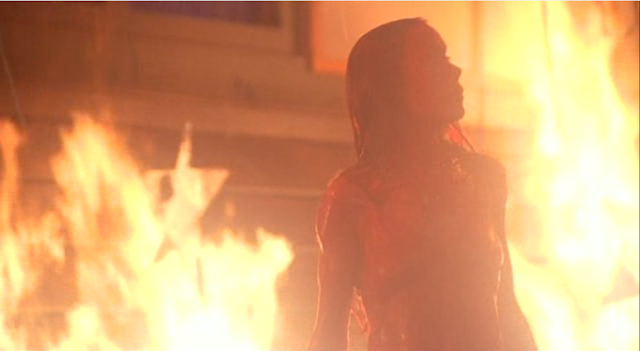


She returns to the house, that familiar temple of childhood, seeking ablution from the day's sins, and finds her mother there in the gathering dusk. Their embrace unfolds like a ritual, ancient and holy, until the silver flash of betrayal - cold steel sliding between ribs - transforms their dance into something primitive and terrible. Down the stairs she tumbles, each wooden step a station of her cross, while above her the mother she once knew becomes something else entirely, something hungry for daughter's blood. And then, in that moment when love curdles to survival, she feels it rise within her: that dark gift, that terrible power. The knives hang suspended in the air like deadly stars before they find their mark, one after another after another, until the woman who gave her life lies still upon the stairs, and the daughter stands trembling in the sudden silence, tasting copper and salt and loss.


In the final frames, mother and daughter embrace amid the splintering timbers of their doomed house, the flames rising like prayer around them. Later, in that peculiar territory between sleep and waking, Sue approaches the charred skeleton of the White residence, where some anonymous prophet has scrawled across the realtor's sign those words of judgment: CARRIE WHITE BURNS IN HELL. As she lays down her offering of flowers - that ancient gesture of remembrance - a hand reaches up through the scorched earth to claim her, and we cannot say with certainty whether it seeks vengeance or forgiveness.

Let us speak plainly of this film's terrible beauty. King has given us no simple monster but rather a creature of magnificent contradiction: a girl-child both omnipotent and utterly helpless, a victim transformed by her own suffering into an instrument of divine retribution. We watch her, this Carrie White, moving through the stations of her passion - the mockery, the brief illusory triumph, the final betrayal - and find ourselves unable to turn away, unable to withhold our sympathy even as the blood begins to flow.

The camera moves through this world like a penitent, genuinely haunted by what it sees. Shadow and light wage their eternal war in every frame, most perfectly in that house of horrors where Carrie and her mother enact their private liturgy of pain. That crucified Christ with his terrible glowing eyes stands witness, both judge and condemned, while mother and daughter circle each other like wary animals, like lovers, like reflections in a warped mirror.

But it is in the performances that this film achieves its true sacramental power. Spacek carries within her slight frame all the fury and despair of the dispossessed; when she unleashes her vengeance at the prom, her eyes contain entire universes of pain. And Laurie, dear God, Laurie - she gives us a portrait of religious mania so precise, so terrifyingly intimate, that we feel we have stumbled upon something we were never meant to see. When she raises that knife against her own flesh and blood, we understand with horrible clarity that this too is an act of love.

This then is horror in its highest form: not mere shock or revulsion, but a perfect storm of image and narrative and human truth, building to a crescendo that leaves us shaken in our deepest places. It is a hymn to the terrible power of love perverted, of faith twisted in on itself until it bleeds.

For movie information visit Carrie post at Cinemunch
This movie is available on available on Amazon - Carrie (Special Edition) or download via iTunes - Carrie - Stephen King
  ________________________________________________________________________________
This is a part of Fright Cinema 2015, a list of the best horror movies handpicked in no particular order by The Wandering Klutz. It features ten (10) films every year just in time for the scariest season of the year.


A rumbling sound then three sharp knocks. Ba BA-ba DOOK! DOOK! DOOK!


Heneral Luna can be considered a seminal cinematic piece with its thought-provoking and emotional stirring screenplay and cinematography. This was clear with the resounding applause of people in the cinema when we watched it last night at Glorietta.

Of all the biopic of local heroes I've seen so far this has by far is a stark improvement with the way we tell the stories of our heroes - one that is humanized with their faults and frailties.

This may be the charm of this film apart from well written verses in Filipino in the script that reminds us how poetic and romantic our language is.

PHILIPPINE NATIONAL IDENTITY


I'm not a historian to confirm how much creative license Jerrold Tarog has given with his interpretation of Luna's life but more than an accurate historical account of Luna's life, this movie is a more of a reflective film about our national identity then and until now. It shows a reflection of what is Filipino Nationalism and Patriotism - an enigma.

 
We were a failed state because ever since the birth of the republic it can be seen that our regionalistic and ethnic views and our primal concern of the family has been detrimental to the development of our national identity. We would sacrifice the common good to preserve or protect the individual self interests of our kin and family. History has proven this point so many times.


COMPLEX LUNA

Tarog painted a complex character in Luna, both endearing and obnoxious. It kept the movie relevant with the audience because people can identify with them. The portrayal of John Arcilla on Luna's various personality was amazing and very convincing. He seamlessly portrayed Luna from being a ferocious general, dotting son and stern patriot.

The movie portrayed the paradoxical nature of Luna as a patriotic general who would be willing to give his life to preserve the Republic by enforcing the rule of law and on the other hand his plain tyrannous approach to leadership especially when his temper flares up.


I find it very confusing at first the hilarity of some scenes, especially the witty and cool banter despite the bloodshed during the battle encounters in the trenches. It may be a statement of the humor of war or a reflection of our culture as well.

Heneral Luna is far from what we have learned in school at least in my generation. To be honest he was not given much attention back then, the focus has always been with Rizal, Bonifacio and Aguinaldo. He was overshadowed as being the brother of Juan Luna, the general during the first republic and Philippine-American war and he has faced a tragic death.


He represented, like most of our heroes who have faced a tragic death in the fight for freedom, the pure idealism of nationalism, which we could hardly understand now.


RECEPTION

These kinds of movies deserves to be rewarded with box office turn-outs to encourage producers to produce more. We have so many heroes and prominent historical figures that have led interesting lives and I believe that the future generation should be given a chance to get to know them not only in textbooks but in the cinema as well.


It has been announced that Heneral Luna will be the official entry of the Philippines to the upcoming 2016 Oscars. Let's cross our fingers that despite the subtle commentary on American Colonialism that it will give us our first Oscar.


For movie information visit Heneral Luna page on Cinemunch

Photo: Heneral Luna Movie, Heneral Luna, Antonio Luna
Older Posts Home

@rdvlsco

Life in Makati, PH

Archive

Visitors

Powered by Blogger.

Copyright © 2015 S p a c e d O u t. Designed by OddThemes