• Home
  • About
  • Audio x Videos
    • Youtube
    • TikTok
    • IG Reels
    • Podcast
the wandering klutz the wandering klutz facebook the wandering klutz pinterest the wandering klutz instagram the wandering klutz soundcloud the wandering klutz youtube pinoy realtors online learning site Online Store Film Information Perspectives Photos Podcast Quote Catalog Digital Shelf Image Map
S p a c e d O u t

"Once" is that rare film that understands how love actually works in the real world - not in the manufactured universe of Hollywood romance, but in the quiet spaces between glances and guitar strings. Set against the gray-washed streets of Dublin, it follows two musicians who are never named - they're simply Guy (Glen Hansard) and Girl (Marketa Irglova). This choice feels right; their story is universal enough to belong to anyone.

What strikes me most about John Carney's film is its refusal to bend to romantic convention. Here is a love story that breathes naturally, like a folk song that's been waiting to be discovered rather than composed. The Guy busks on Dublin streets, pouring his heartache into borrowed melodies. The Girl, a Czech immigrant with her own wounds, recognizes something in his music that speaks to her soul. Their connection isn't built on meet-cute moments or contrived conflict, but on the authentic language of musicianship.

I first encountered "Falling Slowly," the film's signature song, years before seeing the movie, but watching it in context is like finally understanding the meaning of a poem you've long had memorized. The music in "Once" isn't deployed as emotional manipulation - as it so often is in modern musicals - but emerges organically from the characters' lives, as natural as conversation.

Hansard and Irglova aren't actors playing musicians; they're musicians being themselves, and this authenticity bleeds through every frame. When they perform, you're not watching a performance - you're witnessing an emotional excavation. Their characters' pain, hope, and longing are laid bare through lyrics and melody rather than dialogue.

The ending refuses the easy satisfaction of romantic resolution. Guy leaves for London, Girl reunites with her husband, and we're left with the bittersweet understanding that some loves are meant to transform us rather than possess us. It's the kind of ending that feels true to life - not happy, not tragic, but somewhere in that complex middle ground where most of our stories actually live.

"Once" reminds us that the most powerful love stories aren't always about endings, but about moments - those brief intersections of lives that leave us forever changed. It's a film that lingers in your memory like a half-remembered song, its melody haunting you long after the last note has faded.

Four stars.

You can download the movie Once on iTunes - Once (2006)
Photo: Mubi

"Funny Games" is not about satisfying our appetite for violence, but about forcing us to examine it. This is a film that holds up a mirror to our darker impulses, and what we see might make us squirm.

The setup is deceptively simple: A well-to-do family - Ann (Naomi Watts), George (Tim Roth), and their young son Georgie (Devon Gearheart) - retreat to their lake house for what should be an idyllic vacation. Enter two young men in tennis whites, Paul (Michael Pitt) and Peter (Brady Corbert), who arrive asking to borrow eggs and proceed to take the family hostage. What follows is an exercise in calculated cruelty that's all the more disturbing for its restraint.

Director Michael Haneke isn't interested in the usual thriller mechanics. Instead, he's crafting a meditation on violence in cinema and our complicity as viewers. Paul occasionally breaks the fourth wall, shooting knowing smirks at the camera as if to say, "This is what you came for, isn't it?" These moments aren't merely clever meta-commentary; they're indictments.

The film's power lies not in what it shows - indeed, most of the violence occurs offscreen - but in what it makes us confront about ourselves. Why do we watch these films? What do we hope to see? Haneke denies us the cathartic release we've come to expect from the thriller genre, and that denial is precisely the point.

Those seeking conventional thrills will leave disappointed. "Funny Games" is not interested in entertaining us so much as interrogating us. It's a film that refuses to let its audience off the hook, and therein lies both its brilliance and its challenge. Like Paul's unsettling smirk, it knows exactly what it's doing, and it wants us to know too.

Note: I give "Funny Games" three stars, not because it fails at what it sets out to do, but because its success comes at the cost of alienating its audience - which may well be exactly what Haneke intended.


Photo: Popcornography
You can download Funny Games on iTunes - Funny Games 2007

"Knock Knock" begins with a premise as old as cinema itself: a man alone in his house, two mysterious women at his door, and the rain coming down in sheets. But Eli Roth, known for his gleefully grotesque "Hostel," has something more unsettling in mind than mere bloodletting.


Keanu Reeves plays Evan Webber, an architect whose picture-perfect life includes the requisite beautiful wife, adorable children, and modernist house that practically screams "successful professional." When his family departs for a beach weekend, leaving him behind with a shoulder injury, two young women (Lorenza Izzo and Ana de Armas) appear on his doorstep like wolves in sheep's clothing.

What follows is less the expected splatterfest and more a psychological descent into modern anxieties about fidelity, social media, and sexual power dynamics. Roth, typically a conductor of grand guignol orchestra, here plays a subtler tune. The violence, when it comes, is more emotional than physical, though no less devastating.

The film's most interesting choice is its reversal of home-invasion thriller conventions. Instead of brutish men terrorizing a helpless family, we get two seemingly innocent young women whose childlike affect makes their eventual revealed nature all the more disturbing. They're less interested in Evan's blood than his complete psychological destruction.

Some may find the film's more outlandish moments jarring, and Roth occasionally lets his camp sensibilities get the better of him. But there's something compelling about watching this man's carefully constructed life dismantled by forces that seem to have sprung directly from our collective digital-age nightmares.

"Knock Knock" isn't Roth's best work, but it shows him maturing as a filmmaker, trading gore for psychological gamesmanship. It's a thriller that understands sometimes the deepest cuts leave no visible scars.

Three stars.

Photo: Knock Knock

There are moments in F.W. Murnau's "Nosferatu" (1922) when the screen itself seems to emanate darkness. Not merely the absence of light, but something more primordial – a darkness that breathes. This unauthorized adaptation of Bram Stoker's "Dracula" nearly vanished into that darkness forever when Stoker's widow sued for copyright infringement. How fortunate we are that it survived.

The story follows Thomas Hutter (Gustav von Wangenheim), a real estate agent who travels to Transylvania to meet Count Orlok (Max Schreck). But this is not the suave, seductive vampire of later films. Schreck's Orlok is a creature of nightmare – rat-faced, long-fingered, moving with the unnatural stillness of a spider. When he first appears, rising from his coffin in that famous shot, we're seeing one of cinema's most primal images.

What makes "Nosferatu" so powerful isn't what it shows us, but what it suggests. Modern horror films assault us with gore and jump scares, but Murnau understood that true terror lives in shadows and silence. Watch how Orlok's shadow climbs the stairs, his clawed hands reaching up the wall – it's poetry of the macabre, choreographed with the precision of a German Expressionist painting.

The film's visual language speaks volumes in the absence of sound. When Ellen (Greta Schroder) becomes the object of Orlok's desire, the tension builds not through dialogue but through Murnau's masterful composition and pacing. Each frame is arranged with architectural precision, yet somehow feels organic, like a nightmare unfolding in real time.

"Nosferatu" doesn't frighten us with sudden shocks or graphic violence. Instead, it creates a creeping dread that settles into your bones and stays there. It's the kind of film that makes you want to look over your shoulder on the walk home from the theater, even a century after it was made. That's not just horror – that's art.

Great movies change the way we see the world. "Nosferatu" changed the way we see the dark. It remains, after all these years, a masterpiece of shadow and light, of terror and beauty. This isn't just a great horror film – it's a great film, period.


Five Stars


For movie information visit Nosferatu (1922) post at Cinemunch
This movie is available on Amazon - Nosferatu: Kino Classics 2-Disc Deluxe Remastered Edition [Blu-ray] or Download via iTunes - Nosferatu (Remastered) - F.W. Murnau
________________________________________________________________________________
This is a part of Fright Cinema 2015, a list of the best horror movies handpicked in no particular order by The Wandering Klutz. It features ten (10) films every year just in time for the scariest season of the year.


https://www.goldderby.com/article/2023/william-friedkins-the-exorcist-was-a-cultural-sensation/


"The Exorcist" stands as a testament to an era when horror could still claim innocence, when audiences could approach the supernatural with genuine, unironic terror. What we're watching isn't just a film about possession – it's a window into our collective past, when the mere suggestion of evil could send moviegoers fleeing from theaters.

Based on the last documented case of sanctioned exorcism in America, William Friedkin's masterwork transplants the story from a possessed boy to young Regan MacNeil (Linda Blair), daughter of actress Chris MacNeil (Ellen Burstyn). When medicine fails to explain her daughter's grotesque transformation, Chris turns to Father Karras (Jason Miller), a priest wrestling with his own demons of doubt. Enter Father Merrin (Max von Sydow), whose weathered face carries the memory of a previous battle with the ancient demon Pazuzu.

What unfolds is not merely an exercise in shock value, though the film's infamous scenes – the rotating head, the pea-soup vomit, the spider-walk down the stairs – have become part of our cultural vocabulary. Instead, Friedkin crafts a meditation on faith, innocence, and the price of confronting absolute evil. The 1973 release sent shockwaves through American cinema, spawning countless imitators but few equals.

Modern viewers, raised on a diet of CGI monsters and calculated jump scares, might find themselves immune to some of "The Exorcist's" more dated elements. But beneath its supernatural veneer lies a more profound horror: the story of a mother watching her child transform into something unrecognizable. It's also, perhaps unintentionally, a powerful metaphor for puberty and family dissolution – the demon Pazuzu might as well be hormones and divorce papers.

What makes "The Exorcist" endure isn't its ability to shock (though it still can), but its unwavering commitment to treating its subject matter with grave seriousness. Unlike today's horror films, which often wink at their audience, Friedkin's film never breaks character. It believes in its own terrors completely, and that conviction remains its most powerful special effect.

Four stars. This is one of the great ones.


For movie information visit The Exorcist (1973) post at Cinemunch
This movie is available on Amazon - The Exorcist: Director's Cut (Extended Edition) or Download via iTunes - The Exorcist - William Friedkin
________________________________________________________________________________
This is a part of Fright Cinema 2015, a list of the best horror movies handpicked in no particular order by The Wandering Klutz. It features ten (10) films every year just in time for the scariest season of the year.


Great movies work their way into our psyche not through shock, but through suggestion. "The Silence of the Lambs" understands this principle intimately, creating terror not from what we see, but from what we think we might see next.

The plot, adapted from Thomas Harris's novel, seems deceptively straightforward: an FBI trainee interviews an imprisoned cannibalistic psychiatrist to catch another serial killer. But in Jonathan Demme's masterful hands, this becomes a descent into the darkest corners of human nature, where monsters wear human faces and speak in cultivated tones.

Jodie Foster's Clarice Starling isn't your typical thriller protagonist. She's small, vulnerable, haunted by childhood trauma, yet possessed of an steel-like determination that makes her fascinating to both the audience and to Anthony Hopkins' mesmerizing Dr. Hannibal Lecter. Hopkins, in what must be one of cinema's greatest performances, creates a monster so sophisticated and intelligent that his very refinement becomes terrifying. He doesn't just play Lecter; he inhabits him with such conviction that we believe this man could indeed eat someone's liver with fava beans and a nice Chianti.

Demme's direction is a masterclass in psychological manipulation. Notice how the camera lingers just a fraction too long on Lecter's unblinking gaze, how it follows Clarice through cramped corridors that seem to grow narrower with each step. The film's visual grammar speaks directly to our subconscious fears, making us feel trapped alongside its protagonist.

What elevates "The Silence of the Lambs" above mere thriller status is its understanding of the relationship between predator and prey, between power and vulnerability. When Lecter dissects Clarice's psyche with surgical precision, we're watching more than just a psychological game – we're watching a battle for the soul.

This is filmmaking of the highest order, where every element – from the rain-soaked palette to Howard Shore's unsettling score – works in perfect harmony to create an atmosphere of mounting dread. It's a rare film that can make simple conversation more frightening than any graphic violence, but "The Silence of the Lambs" accomplishes exactly that.

In the pantheon of psychological horror, few films have achieved such a perfect synthesis of performance, direction, and psychological insight. It's not just a great thriller; it's a great film, period. And like all great films, it leaves us changed, making us question our own capacity for both good and evil. That's what makes it not just memorable, but unforgettable.


For movie information visit Silence of the Lambs post at Cinemunch
This movie is available on Amazon - The Silence of the Lambs or Download on iTunes -The Silence of the Lambs - Jonathan Demme

________________________________________________________________________________
This is a part of Fright Cinema 2015, a list of the best horror movies handpicked in no particular order by The Wandering Klutz. It features ten (10) films every year just in time for the scariest season of the year.

When I saw a stage musical based on the movie Carrie a few years ago in RCBC Theater I said to myself I should see the original movie and I liked it.


Here was the girl-child Carrie White, portrayed with devastating clarity by Sissy Spacek, moving like a wounded bird through the shadowed halls of her high school prison. Here too was her mother, that terrible angel of righteousness played by Piper Laurie, whose love twisted like barbed wire around her daughter's throat. They dwelled together in that small house that seemed to lean away from God's grace, though the mother spoke His name unceasingly.

The shower room scene unfolds like a nightmare remembered in fever: the first bloom of womanhood arriving in steam and confusion, the bright blood that sparked terror in the uninitiated girl. Her classmates, those cruel priestesses of adolescence, rained down their mockery along with the feminine articles of their scorn. And then - witness - the light above shattering in response to her distress, glass falling like sharp tears.

The power in her grew like a secret vine, manifesting in small violences: an ashtray sliding across polished wood when her name was misspoken, a boy's bicycle upending when his taunts found their mark. These were mere whispers of what was to come, like distant thunder before the storm breaks.


Upon returning home she would face her mother who instead of consoling, forces her to pray for forgiveness as this was the curse of blood.


In the stark gymnasium that afternoon, beneath fluorescent lights that hummed like distant wasps, Ms. Collins delivered her judgment upon those cruel young women who had made of Carrie White their sport and shame. The punishment fell like a gavel: detention, and running endless circles upon the oval track where spring heat rose in visible waves. But Chris—beautiful, terrible Chris—her face a mask of privilege and rage, would not bend to this authority. When Ms. Collins' hand struck her cheek, it was as if some ancient contract had been broken. Chris' defiance rose like bile in her throat, her words seeking to poison the others against their teacher's decree. Yet she found herself alone in her rebellion, for Ms. Collins stood as an implacable wall between Chris and any who might have followed her, and in that moment the girl's power withered like cut flowers in August sun, leaving her isolated in the vast echo chamber of her own fury.


Burdened by the weight of conscience, young Sue—her face a portrait of earnest remorse—beseeches her beloved Tommy to extend an invitation to Carrie for the approaching ritual of youth, the Senior Prom. The girl, Carrie, her eyes wary with the accumulated hurts of years, first recoils from this offering like a wounded creature, suspecting yet another cruel deception, before allowing herself to grasp at this tenuous promise of normalcy. In the dim confines of her home, where shadows gather thick as sin, she faces her mother's religious fury, wielding her terrible gift—that power which sets her apart from all others—to pin the woman's resistance to the wall like a moth to cork, and steps out into the night.

Meanwhile, in darker corners, malice takes shape: Chris, that vessel of teenage cruelty, conspires with her lover Billy, their faces lit by the sickly glow of vengeance. Above the stage they position their weapon: a bucket brimming with pig's blood, that ancient symbol of sacrifice and shame. Through Norma's manipulations—swift fingers moving across ballots like spiders weaving their web—Carrie ascends to her moment of false triumph, crowned queen of this mockery. But heaven holds no mercy: the blood descends, a red baptism of humiliation, and in Carrie's fracturing mind, the laughter of her peers swells like a terrible chorus, echoing through the chambers of her consciousness with the force of thunder.


In that moment of supreme humiliation and fury - twin demons writhing beneath her skin - she summoned forth powers dark and terrible, sealing shut every door, every window, every possible avenue of escape, while the gathered masses inside began to comprehend their fate. The gymnasium became their tomb, their prison, their final theater, as she orchestrated their end with cold precision. Later, flames would purify it all. Through some cruel miracle, Chris and Billie found their way to freedom, but in their desperate flight, their attempt to strike her down with mere steel and speed, she lifted their vehicle as if it were a child's toy, held it suspended in the air like a terrible offering, before letting it burst into a blossom of fire against the indifferent night sky.
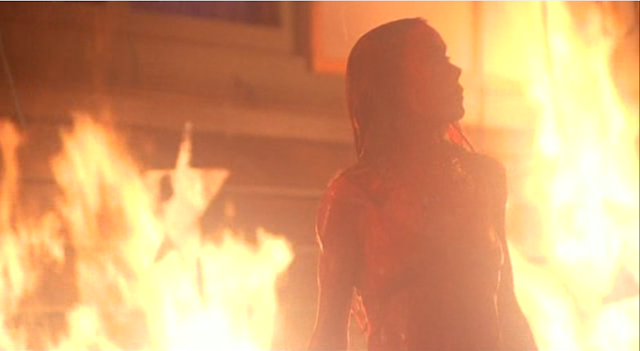


She returns to the house, that familiar temple of childhood, seeking ablution from the day's sins, and finds her mother there in the gathering dusk. Their embrace unfolds like a ritual, ancient and holy, until the silver flash of betrayal - cold steel sliding between ribs - transforms their dance into something primitive and terrible. Down the stairs she tumbles, each wooden step a station of her cross, while above her the mother she once knew becomes something else entirely, something hungry for daughter's blood. And then, in that moment when love curdles to survival, she feels it rise within her: that dark gift, that terrible power. The knives hang suspended in the air like deadly stars before they find their mark, one after another after another, until the woman who gave her life lies still upon the stairs, and the daughter stands trembling in the sudden silence, tasting copper and salt and loss.


In the final frames, mother and daughter embrace amid the splintering timbers of their doomed house, the flames rising like prayer around them. Later, in that peculiar territory between sleep and waking, Sue approaches the charred skeleton of the White residence, where some anonymous prophet has scrawled across the realtor's sign those words of judgment: CARRIE WHITE BURNS IN HELL. As she lays down her offering of flowers - that ancient gesture of remembrance - a hand reaches up through the scorched earth to claim her, and we cannot say with certainty whether it seeks vengeance or forgiveness.

Let us speak plainly of this film's terrible beauty. King has given us no simple monster but rather a creature of magnificent contradiction: a girl-child both omnipotent and utterly helpless, a victim transformed by her own suffering into an instrument of divine retribution. We watch her, this Carrie White, moving through the stations of her passion - the mockery, the brief illusory triumph, the final betrayal - and find ourselves unable to turn away, unable to withhold our sympathy even as the blood begins to flow.

The camera moves through this world like a penitent, genuinely haunted by what it sees. Shadow and light wage their eternal war in every frame, most perfectly in that house of horrors where Carrie and her mother enact their private liturgy of pain. That crucified Christ with his terrible glowing eyes stands witness, both judge and condemned, while mother and daughter circle each other like wary animals, like lovers, like reflections in a warped mirror.

But it is in the performances that this film achieves its true sacramental power. Spacek carries within her slight frame all the fury and despair of the dispossessed; when she unleashes her vengeance at the prom, her eyes contain entire universes of pain. And Laurie, dear God, Laurie - she gives us a portrait of religious mania so precise, so terrifyingly intimate, that we feel we have stumbled upon something we were never meant to see. When she raises that knife against her own flesh and blood, we understand with horrible clarity that this too is an act of love.

This then is horror in its highest form: not mere shock or revulsion, but a perfect storm of image and narrative and human truth, building to a crescendo that leaves us shaken in our deepest places. It is a hymn to the terrible power of love perverted, of faith twisted in on itself until it bleeds.

For movie information visit Carrie post at Cinemunch
This movie is available on available on Amazon - Carrie (Special Edition) or download via iTunes - Carrie - Stephen King
  ________________________________________________________________________________
This is a part of Fright Cinema 2015, a list of the best horror movies handpicked in no particular order by The Wandering Klutz. It features ten (10) films every year just in time for the scariest season of the year.


A rumbling sound then three sharp knocks. Ba BA-ba DOOK! DOOK! DOOK!


Stupid is funny.

"Tucker and Dale vs Evil" arrives like a gleaming machete, slicing through the dense undergrowth of horror movie clichés. Here is a film that understands the DNA of cabin-in-the-woods slasher flicks so intimately that it can dissect them with surgical precision and abundant wit.

The setup is deceptively simple: Two good-hearted hillbillies, Tucker (Tyler Labine) and Dale (Alan Tudyk), venture to their newly acquired fixer-upper cabin in the wilderness. At a ramshackle establishment bearing the ominous name "Last Chance Gas" - itself a knowing wink to every horror film where civilization ends at a rustic pump station - they encounter a group of college students who mistake their awkward friendliness for backwoods menace.

What follows is both homage and subversion, like watching a familiar horror movie in a funhouse mirror. The film understands that sometimes the scariest monster is the one we create in our minds when we judge others too quickly. Labine and Tudyk, with their earnest performances, become our guides through this clever deconstruction of horror tropes.

The woods. Pretty creepy and a lot of room for a murderous rampage.

In a delicious twist of misunderstanding, our paths cross again at the lake, where collegiate revelry meets backwoods innocence. When Allison (played with bubbly charm by Katrina Bowden) slips on a moss-slicked rock during a midnight skinny-dipping excursion, Tucker and Dale rush to her aid - but through the fog of prejudice and panic, her friends see only the nightmare their imagination has conjured. To them, these well-meaning hillbillies are suddenly transformed into backwoods bogeymen, straight out of every horror movie cliché they've internalized.

What follows is a symphony of slapstick tragedy, as the college kids' attempts at vigilante justice become an exercise in accidental self-destruction. One by one, they fall victim not to murderous hillbillies, but to their own misguided crusade - a pointed commentary on how fear can make us architects of our own undoing.

This guy loves clippings


"Tucker & Dale vs. Evil" walks a delicate tightrope between horror and hilarity, and somehow manages not to fall. Like "Shaun of the Dead" before it, it understands that the best genre parodies come from a place of genuine affection rather than mockery.

The film cleverly subverts every backwoods slasher trope in the book: the West Virginia setting (borrowed from "Wrong Turn"), the supposedly menacing hillbillies (a nod to "Texas Chainsaw Massacre"), and the parade of college stereotypes who meet their demise in increasingly spectacular fashion. We get the promiscuous party girl, the bookish nerd, the token African-American, and the virginal hero – all horror movie staples that the film gleefully deconstructs.

What's remarkable here is the film's precise calibration of tone. Just when the blood starts flowing – and flow it does – the movie pivots to comedy with the precision of a surgeon's scalpel. Yet unlike lesser entries in the horror-comedy genre, it never descends into pure farce. There's a sweetness at its core, a humanity that keeps the proceedings grounded even as the body count rises.

The filmmakers understand something crucial: restraint. By not pushing the humor into the realm of the absurd, they maintain just enough plausibility to keep us invested. It's a neat trick, making us laugh at death while simultaneously making us believe in the world they've created.

In a genre where most films stumble into self-parody, "Tucker & Dale" maintains its balance. Yes, it teaches us not to judge others by their appearance and not to accidentally impale ourselves on sharp objects – both worthy lessons – but it does so while remaining consistently entertaining.

Three stars


For movie information visit Tucker and Dale vs Evil post at Cinemunch
This movie is available on Amazon - Tucker & Dale vs. Evil
This is a part of Fright Cinema 2015, a list of the best horror movies handpicked in no particular order by The Wandering Klutz. It features ten (10) films every year just in time for the scariest season of the year.


Heneral Luna can be considered a seminal cinematic piece with its thought-provoking and emotional stirring screenplay and cinematography. This was clear with the resounding applause of people in the cinema when we watched it last night at Glorietta.

Of all the biopic of local heroes I've seen so far this has by far is a stark improvement with the way we tell the stories of our heroes - one that is humanized with their faults and frailties.

This may be the charm of this film apart from well written verses in Filipino in the script that reminds us how poetic and romantic our language is.

PHILIPPINE NATIONAL IDENTITY


I'm not a historian to confirm how much creative license Jerrold Tarog has given with his interpretation of Luna's life but more than an accurate historical account of Luna's life, this movie is a more of a reflective film about our national identity then and until now. It shows a reflection of what is Filipino Nationalism and Patriotism - an enigma.

 
We were a failed state because ever since the birth of the republic it can be seen that our regionalistic and ethnic views and our primal concern of the family has been detrimental to the development of our national identity. We would sacrifice the common good to preserve or protect the individual self interests of our kin and family. History has proven this point so many times.


COMPLEX LUNA

Tarog painted a complex character in Luna, both endearing and obnoxious. It kept the movie relevant with the audience because people can identify with them. The portrayal of John Arcilla on Luna's various personality was amazing and very convincing. He seamlessly portrayed Luna from being a ferocious general, dotting son and stern patriot.

The movie portrayed the paradoxical nature of Luna as a patriotic general who would be willing to give his life to preserve the Republic by enforcing the rule of law and on the other hand his plain tyrannous approach to leadership especially when his temper flares up.


I find it very confusing at first the hilarity of some scenes, especially the witty and cool banter despite the bloodshed during the battle encounters in the trenches. It may be a statement of the humor of war or a reflection of our culture as well.

Heneral Luna is far from what we have learned in school at least in my generation. To be honest he was not given much attention back then, the focus has always been with Rizal, Bonifacio and Aguinaldo. He was overshadowed as being the brother of Juan Luna, the general during the first republic and Philippine-American war and he has faced a tragic death.


He represented, like most of our heroes who have faced a tragic death in the fight for freedom, the pure idealism of nationalism, which we could hardly understand now.


RECEPTION

These kinds of movies deserves to be rewarded with box office turn-outs to encourage producers to produce more. We have so many heroes and prominent historical figures that have led interesting lives and I believe that the future generation should be given a chance to get to know them not only in textbooks but in the cinema as well.


It has been announced that Heneral Luna will be the official entry of the Philippines to the upcoming 2016 Oscars. Let's cross our fingers that despite the subtle commentary on American Colonialism that it will give us our first Oscar.


For movie information visit Heneral Luna page on Cinemunch

Photo: Heneral Luna Movie, Heneral Luna, Antonio Luna
What we do in the shadows
The Vampires are having a flat meeting to discuss about the division of chores.


"What We Do in the Shadows" achieves something remarkable: it makes the undead feel utterly, hilariously alive. Through the lens of a mock documentary crew, we peer into the mundane existence of four vampires sharing a flat in New Zealand - a premise that could have been merely clever but instead proves inspired. Like the best mockumentaries, it understands that true comedy lies not in the supernatural elements, but in the delicious banality of everyday (or rather, everynight) life.

The film arrives just weeks before the Unholy Masquerade, a grand gathering of supernatural beings that looms over the narrative like a gothic prom night. But it's in the smaller moments - the squabbles over dishes, the passive-aggressive Post-it notes about cleaning blood stains - where the film finds its beating heart. The documentary format, previously wielded to devastating effect in works like "Borat," here serves as both storytelling device and sly commentary on our reality-TV obsessed culture.

What emerges is not just a comedy about vampires, but a sharp meditation on the nature of immortality itself. After all, what could be more darkly funny than eternal beings struggling with roommate dynamics?


what we do in the shadows

what we do in the shadows


What we have here is more than just a vampire comedy - it's a wickedly clever mirror held up to our modern social anxieties. The film sinks its teeth into everything from sexual identity to millennial malaise, but does so with the kind of knowing wink that makes the medicine go down smooth. Consider Viago, our fastidious vampire roommate, whose obsession with coasters and cleaning protocols isn't just played for laughs - it's a brilliant send-up of privileged sensitivity gone haywire. Here's a creature of the night more concerned with furniture stains than feeding, perfectly embodying that peculiarly modern affliction of caring too intensely about everything while missing the bigger picture.

The genius lies in how it transforms mundane roommate squabbles into metaphors for larger social commentary. When Viago nags about newspaper-lined feeding areas and proper dish-washing technique, we're really watching a satire of first-world problems played out in supernatural drag. It's the kind of detail that makes you laugh while simultaneously recognizing yourself in these immortal beings' all-too-human foibles.


The sheets didn't work.


Modern day vampire hypnosis and seduction.

Nick coming out to his best friend Stuart on being a Vampire

Time melts away during this mesmerizing film, leaving you hungry for more - a rare feat in today's landscape of bloated runtimes. After years of enduring the anemic offerings of vampire cinema (particularly the somnolent "Twilight" saga, where even the action sequences served as impromptu nap times), this film arrives like a transfusion of fresh blood into the genre.


PS. Want to watch this movie? Purchase this movie via Amazon.Com (affiliate link) by clicking the link below and this is available in Blue Ray! Enjoy!


Photo Credits: What We do in the Shadows


Inside Out stands as Pixar's most emotionally resonant work since Up, achieving what great cinema does best: it makes us feel deeply, irrevocably, and without shame. This is a film that understands the exquisite pain of growing up.

At its heart lies Riley, a young girl whose mind becomes our universe for two transcendent hours. Within the labyrinth of her consciousness dwell five emotional avatars – Joy (Amy Poehler), radiating with the warmth of summer days; Fear (Bill Hader), perpetually braced for disaster; Anger (Lewis Black), a compact furnace of frustration; Disgust (Mindy Kaling), protecting Riley's social and literal taste buds; and Sadness (Phyllis Smith), whose blue melancholy proves more essential than anyone suspects.


When Riley's family transplants from the snowy comfort of Minnesota to the alien shores of San Francisco, her emotional command center – cleverly dubbed "Headquarters" – descends into crisis. Joy and Sadness become accidental exiles in the vast architecture of Riley's mind, leaving their emotional colleagues to navigate unfamiliar waters without their captain. The result is a psychological perfect storm, as Riley's remaining emotions flail like novice sailors in rough seas.


What emerges is not just a story about feelings, but a deeply human meditation on how we become who we are, one memory at a time.


Inside Out marks a triumphant return to form for Pixar, reminding us why the studio became synonymous with animated excellence in the first place. I've waited a year for this film, carrying that peculiar mix of hope and trepidation that accompanies any highly anticipated release. The wait, I'm pleased to report, was worth it.

What Pixar has accomplished here is nothing short of miraculous: they've turned the abstract concept of human emotions into a vibrant, living universe that feels as real as the streets outside your window. The film operates on two levels – there's the dazzling visual playground that will entrance younger viewers, complete with clever sight gags and physical comedy, but beneath that lies a sophisticated meditation on the role of emotions in human development that will resonate deeply with adults.

The premise – anthropomorphized emotions battling for control inside a young girl's mind – could have easily descended into saccharine territory or pseudo-psychological babble. Instead, it soars. The film's exploration of pre-adolescent emotional turbulence feels authentic and earned, never condescending or simplified for mass consumption.

Most remarkably, Inside Out dares to suggest something profound: that our society's relentless pursuit of happiness might be misguided. The film posits that sadness, fear, and even disgust serve essential functions in our emotional ecosystem. Joy, brilliantly voiced by Amy Poehler, must learn this lesson along with us. It's a message that feels particularly vital in our era of enforced positivity and Instagram-perfect lives.

The voice casting is impeccable, the animation is sumptuous, and the storytelling is as sharp as anything in Pixar's considerable arsenal. But what lingers after the credits roll is something rarer: a genuine insight into the human condition, wrapped in the bright colors and visual wit we've come to expect from the studio. This isn't just great animation – it's great filmmaking, period.

Photo Credits: Inside Out
Older Posts Home

@rdvlsco

Life in Makati, PH

Archive

Visitors

Powered by Blogger.

Copyright © 2015 S p a c e d O u t. Designed by OddThemes